

Joseph Wright of Derby (1768). An experiment on a bird in the air pump.
Oil on Canvas 182.9x 24.3. National Gallery, London
This Tuesday's seminar will focus on the paintings of Joseph Wright of Derby (1734-1797), who lived and worked in the Eighteenth Century - an age known as the Enlightenment or the 'Age of Reason'. Although he travelled in Italy he spent most of his life in his home town of Derby - which was no provincial backwater, but a centre of England's industrial revolution.
Wright's Candlelight Pictures (of which the above is one example) were his most famous works - employing a chiaroscuro technique. As David Solkin and others have suggested (cited in Daniels, 1999:12), the Candelight Pictures can be related to John Locke's notion of the mind as a dark chamber 'to which the eye lets in images of the external world to be stored and reflected upon' (Daniels, Ibid.).
The painting 'An experiment on a bird in the air pump' will be explored in some detail, looking at allegorical elements and the way in which Wright uses (in this and a number of his works) secularised religious imagery within a new context of science and technology. The bird in the air pump, for example, takes the place of the 'paroclete' in earlier religious paintings - the dove symbolising the Holy Spirit, as in Piero Della Francesca's Baptism of Christ, below
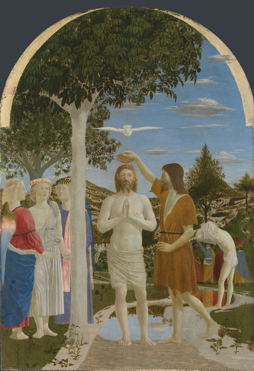
Piero della Francesca (1450s) Baptism of Christ.
Egg tempera on poplar 167x116cm.
National Gallery, London
http://www.nationalgallery.org.uk/paintings/piero-della-francesca-the-baptism-of-christ
Bibliography
Daniels S. (1999). Joseph Wright. London: Tate Gallery Publishing
Paulson, R. (1975). Emblem and expression: meaning in English art of the Eighteenth Century.


No comments:
Post a Comment