

Ernst Haeckel (1899-1904) Ascidiae. Table 85. Kunstformen der Natur. Available from http://caliban.mpiz-koeln.mpg.de/haeckel/kunstformen/Tafel_085.html (Accessed 20 February 2011)
The above illustration by Ernst Haeckel's (1834-1919) of Ascidiae (since renamed Ascidiacea) or 'sea squirts', is taken from his enormously popular work Kunstformen der Natur. Published between 1899 and 1904 in a series of 10 lavishly illustrated installments comprising 100 plates, this work surveyed, primarily visually, the animal kingdom. (The sea squirts are interesting because these humble creatures, which you might come across in rocky seashore pools, possess a structure called a 'notochord' which, in evolutionary terms, is related to the more complex backbone possessed by all vertebrates, including ourselves.)
Haeckel's Kunstformen der Natur was very popular with the general public and, as Breidbach notes, 'the plates spread ripples far beyond the zoological community, and were especially popular among artists and architects of Art Nouveau [Jungendstil]' (2006: 229). In fact he had already influenced art and design: Haeckel's illustrations of radiolaria (small unicellular creatures found in the ocean) had provided the inspiration for Rene Binet's gateway to the Paris Exposition of 1900 (Ibid. 76).
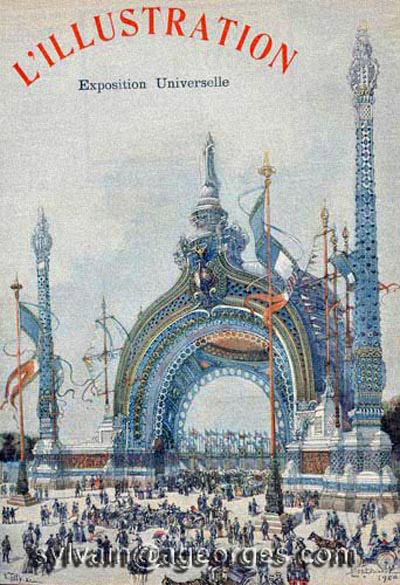
Rene Binet's gateway to the Paris Exposition of 1900. Image available at: http://www.expositions-universelles.fr/1900-photo/1900-binet-04.jpg

In science Haeckel was particularly significant for championing Charles Darwin's theory of evolution by natural selection. In terms of the illustration of science his work was unusual in advancing a predominantly visual argument in which the limited use of text appeared to relegate words to shedding light on the pictures:
'His images, his analytical eye as reproduced in the illustrations he did [in Kunstformen der Natur] was for him the manifesto of his understanding of nature - the text in his accompanying explanations illuminated the illustrations, not vice versa'
(Breidbach 2006: 230).
(Breidbach 2006: 230).
However, Haeckel's extension of Darwin into a kind of social Darwinism (never sanctioned by Darwin himself) took the notion of evolution into a racial and cultural arena. Ultimately Haeckel embraced a kind of proto-fascism (founding the right-wing German Monist League) and his ideas were, after his death, later acclaimed by the German Nazi regime.
High resolution images (and text) from Haeckel's Die Radiolarien and Kunstformen der Natur are available online (see the bibliography below).
Bibliography
Breidbach, Olaf. (2006). Visions of Nature: the art and science of Ernst Haeckel. Munich: Prestel. Haeckel E, Kunstformen der Natur, Kurt Stubers Online Library http://caliban.mpiz-koeln.mpg.de/~stueber/haeckel/kunstformen/liste.html (Accessed 20 February 2011)
Haeckel E, Die Radiolarien, Kurt Stubers Online Library http://www.biologie.uni-hamburg.de/b-online/radio/ (Accessed 20 February 2011)
Haeckel E, Die Radiolarien, Kurt Stubers Online Library http://www.biologie.uni-hamburg.de/b-online/radio/ (Accessed 20 February 2011)


No comments:
Post a Comment